Product Design Document 1 Research. — 2020

Product Design Document 1 Research.

I decided to begin my research by looking into mythological creatures when getting inspiration for the creatures and bosses id be using for my games.
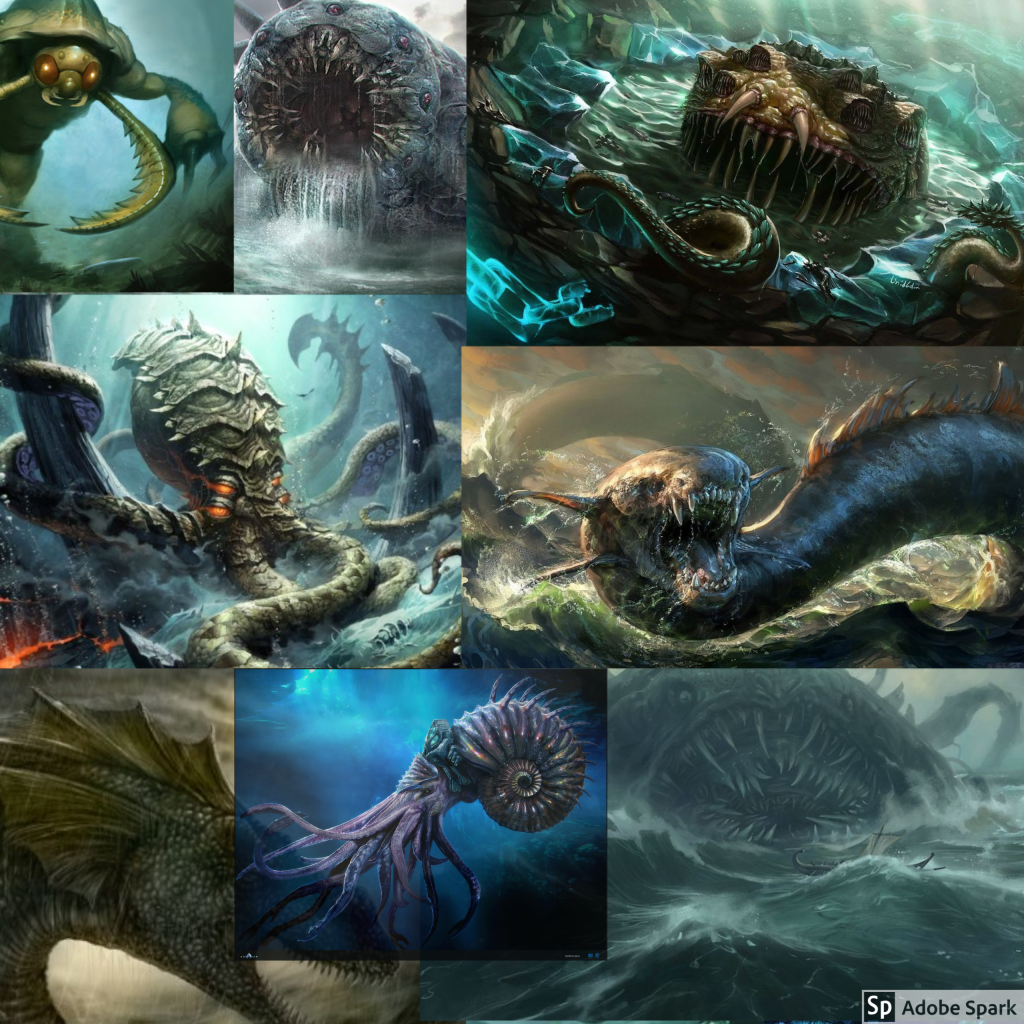
As you can see from the mood board i created above most the creatures ive been looking into come from the sea so they all share fish like features, such as scales, fins and teeth. However as you can see from the entities above most of them have tentacles and rows of teeth. Some of them also have other features such as Dragon wings, claws.Although the entities are all different they are all disturbing to look at with having very horrific features, such as multiple faces and holes. Many of the monsters have long,noticeable limbs making the images very unsettling to look at.

Overall im very happy with how the mood board turned out, it shows the diverse and unique features of the creatures and all of them are individually different in design which one of my favorite things about them.

One of the reasons why i choose to create a mood board on sea monsters and mythical creatures is largely due a selection of YouTube videos i watch a few months ago on things such as the Bermuda Triangle and giant sea monsters or extinct animals, so for my game design document i just compiled the two together.

Bermuda Triangle conspiracies -creating game lore.

Due to the multiple disappearances of aircraft and ships inside the zone known as “The Bermuda Triangle” it was a given that people would start creating conspiracy theories on what caused these disappearances. I’ve decided to research further into these theories so that i can get some ideas for when i create the lore/ story behind my game.

The term “Bermuda Triangle was created bythe writer Vincent Gaddis in 1964.

One of the more outrageous theories involves the fictional underwater city Atlantis. This theory suggests that the mythical city may lie at the bottom of the sea and maybe using its reputed “crystal energies” to sink ships and planes.

However, a more fanciful suggestions include time portals and extraterrestrials — including rumors of underwater alien bases.

Others believe that the reasoning behind the disappearances lies behind some sort of extremely rare, perfectly natural explanation. For example the planes and ships that go missing inside the triangle are actually being destroyed by pockets of flammable methane gas, which is known to exist in large quantities under the sea – there is a chance that a lightning strike ignited a huge bubble of methane that came to the surface right next to a ship or plane, causing them to sink without a trace.

Another suggestion is that rouge tidal waves. Or maybe there is some mysterious geomagnetic anomaly which creates navigational problems confusing pilots and somehow causing them to plunge into the ocean.

Theories sourced from – Radford, B. (2012). Bermuda Triangle: Where Facts Disappear. [online] livescience.com. Available at: https://www.livescience.com/23435-bermuda-triangle.html [Accessed 6 Mar. 2020].

Product Design Document 1 — 2020

Product Design Document 1

Game/Product Identity/ Focus:
Create an unconventional island environment, taking inspiration from folklore and Greek mythology to create the monsters .

Design Pillars:
1 Disorientating

2 Immersive

3 Isolated

Genre/Story/Mechanics Summary:
Firs person action role-playing game. Set somewhere on an island deep inside the Bermuda triangle, the player is surrounded by washed up ships and aircraft proving that the conspiracies about the triangle are actually true, however there is a lot more in store for the player as the story unfolds.

Mechanics: Melee combat vs enemies and bosses, with the ability to unlock combos combining movement with melee attacks.

Features:
Features or unique elements that you want to include in your game:

Unique element: Adrenaline meter during boss fights – used mainly to reward skilled players for not being hit by a boss for a certain amount of time

How it works: In order for the meter to be fully filled up it requires the player to not get hit for a certain amount of time while fighting a boss, the time required for the meter to reach full will vary on boss difficulty. Once the meter has completely filled up, the player is able to active the buff. This buff increases the damage of critical hits inflicted onto a boss by a player.

Interface:
Player input method, the controls, and how the player interacts with your game:

Controls: Basic PC game keybindings, so WASD, shift, ctrl, spacebar. Then interact key(s).

Software: Unity + Cinema4D.

Development Roadmap / Launch Criteria:

Platform: MAC/PC

Audience: Mature 16+ fans of RPGs and action games.

Milestone 1 Finish the necessary research

Milestone 2 Have the game concept down+art style

Milestone 3 Have assets created

Milestone 4 Have the environment finished.

Product Design Document 2

Game/Product Identity/ Focus: Simple 2D side-scroller, players must overcome obstacles and beat the enemies in their way in order to escape the temple.

Design Pillars

1 Easy to pick up and play.

2 Replay-ability

3 Fast-paced

Genre/Story/Mechanics Summary:

Genre: 2D side scroller game

The player must work their way through the rooms (levels) in order to escape the temple. The different rooms found inside of the temple will contain different mobs and traps – each ranging in difficulty and reward.

Mechanics:Main game mechanic being able to jump. Being used to dodge incoming projectiles, traps and gaps.

Feature: Lives, set amount of lives available for each run through of the game until its completed.

Interface controls: Standard controls, WASD and space for jump.

Software: Cinema4D, Unity, Adobe After Effects

Platform: MAC/PC

Audience: Doesn’t have a set demographic, 12+ majority expected.

Milestone 1 Have the art style/color scheme down.

Milestone 2 Create main character and design the traps and enemies.

Milestone 3 Have the level designed with everything in place (traps and enemies)

Milestone 4 Fully test the level and have it completed.

Product Design Document 3

Game/Product Identity/ Focus:

Expand upon my last game environment, creating more rooms and assets but also going into more detail on my original models.

Design Pillars:

1.Photo-realistic

2.Gritty

3. Claustrophobic

+ Use real life examples for design referencing

Interface controls: Standard controls set by unity if i decide to port over the environment if i have time.

Software: Unity (maybe) Cinema4D mainly, although i might try out Photoshop or Substance painter for texturing.

Platform: MAC/PC

Milestone 1 Have the necessary research to begin the project completed.

Milestone 2 Use this research to put together a mood board of images to use for reference when planning out parts of the new environment + selecting the assets i want to create.

Milestone 3 Have the assets created and scene built.

Milestone 4 Finalize design and go over the finer details.

Final Major Project. — 2020

Final Major Project.

Planning & Preparing:

During my project im going to be setting myself three aims. These aims will give me an understanding of my progress during the project and will show evidence that ive managed to make improvements over the course of the project.

AIM 1

Become more comfortable with using Unity. With the previous game environment i created for units 6&7 i ideally wanted to transfer it over to unity however i never go around to doing so due to time limitations and my own lack of experience with unity.

  • To explore on the internet for beginner tutorials for creating game environments on unity.
  • To create a game environment on unity.
  • To analyse other peoples similar game environments and compare them to my own, taking inspiration from them.

AIM 2

Widen my 3D modelling abilities in Cinema4D

  • Assess my previous 3D assets and then find room for improvement on my newer models ill be creating for this project.
  • To plan out and create my environment in Cinema4D before taking it into unity, so that i can experiment with where i want everything to be laid out and structured and figure out any issues before hand.

Aim 3

Create concept art for my game, on the different characters and locations

  • To experiment with Adobe Illustrator to create this concept art.
  • To research what makes concept art successful and explore into different styles of concept art for a variety games.
  • To explore different art styles.

What is a Content Creator? — 2020

What is a Content Creator?

Task 1: Content Creator Analysis

Félix Lengyel, better known by his online alias xQc or xQcOW is a French-Canadian Twitch streamer and Internet personality.

Making a name for himself during his rise in competitive Overwatch, landing himself a spot on Dallas Fuel as main tank. Having also played for team Canada competing in all 3 of the OW World Cups (2017,2018 and 2019.) He without a doubt left an impact on the community, being argued as one of the best during his short lived pro career.His pro career ended abruptly due to his “repeated controversy” over the span of a few months, all this controversy around his name at the time finally resulted in him being suspended from the Overwatch League and dropped from his position in the Dalas Fuel.

With all this publicity around him at the time xQc used this to really kickstart his twitch career. It wasn’t uncommon for Félix to spend anywhere between 12-16hours daily streaming mainly just Overwatch in the early months of his streaming career, but now he mostly plays a variety of games on his twitch channel, his main and most streamed category isn’t Overwatch, in-fact its “Just Chatting”, being included at the start of almost every stream. He spends his time in the “Just Chatting” category reacting to fan made content, videos and recently opening items he receives in his PO Box. His reactions and content created on streams are then cut, edited and uploaded to YouTube establishing its own mini series on his channel xQcOW.

Since streaming xQc generates his revenue in a variety of ways, whether it be from monthly twitch subscriptions from viewers, sponsored streams from game developers, adverts which play before watching his channel if you’re not subscribed to him and finally the most notable donations, there are 2 main types of donations Félix receives on stream. Because donating allows for fans to write personalised messages directly to xQc via a text to speech bot, it didn’t take long for this to abused by his viewers, using it to spam who spam the 3 dollar TTS bot with spam and comments which cause chat reaction or just tilt Félix even more, seeing xQc rage and smashing his desk on stream happens daily resulting in him then yelling in a blend of French and broken English. Seeing him act like this isn’t a rare occurrence, just ask his long time or regular viewers.

Having amassed over 2 million followers on Twitch and 600k+ subscribers on his personal YouTube channel, his target audience is quite varied based on what he’s streaming at the time, although mainly his audience is anywhere between 15 and 25 years old, yet his content isn’t limited to this.

The main branding for both is Twitch and Youtube is largely based upon Winston, a hero from the game Félix used to play professionally. His logo is quite subtle and simple, which is the complete opposite to his personality and stream environment.

Compared to most streamers of his size and calibre, Félix doesn’t stream from a flashy office or have highly produced animations and overlays, he’s kept his stream near enough the same as when he started years ago in his bedroom, to this day most of xQcs daily streams he streams from his bedroom which allows for his fans to be able to relate to him, unlike other streams such as Ninja or DrDisrespect who have green screens, full production teams, animations etc etc.

Felix Arvid Ulf Kjellberg, known as PewDiePie online is a Swedish YouTuber and online personality. Felix is the creator of the most subscribed YouTube channel to date, having earned over 103 million subscribers, placing him king of YouTube, since he started in early 2010 he has accumulated over 24 billion total video views in just under 10 years.

Its no lie that Felix is generating his main income from his YouTube, from advertisements placed before, during and after his videos. Yet he has other avenues of income, such as his clothing drops and merch store, not to mention the mobile phone games he’s had part in developing, such as Tuber Simulator, a game which fans can get a deeper understanding of what its like to be a content creator in their own virtual world, starting from scratch with no subscribers or influence as Felix did back in 2010.

Promotion wise Felix’s presence is felt allover the internet, having a thriving communities on twitter, instagram, reddit- the list goes on. Everyone who needs to know about PewDiePie pretty much already does so in terms of growth its pretty much just natural for Felix’s whole brand now. His styles of videos has really progressed over the years, changing from a game lets play channel to a sit down, comedic channel where most of his videos include fan interaction on his reddit or twitter.

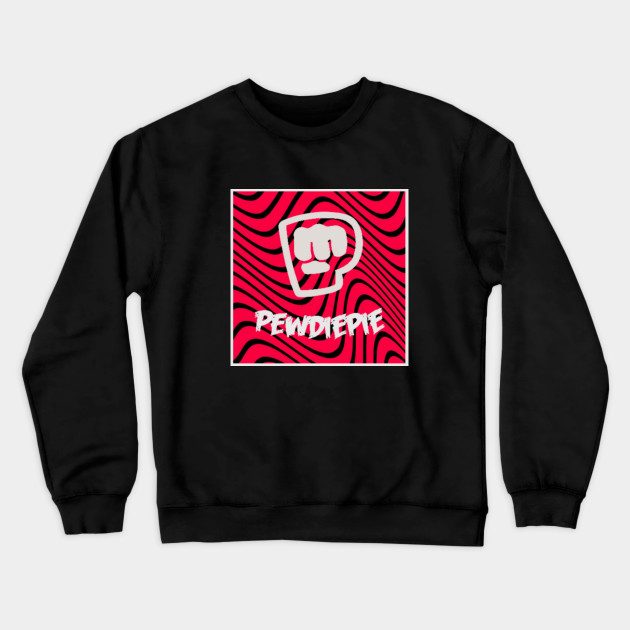
The PewDiePie brofist is the main staple of his brand, with him using it as his old logo and outro for his videos, it was a way for his fans to interact with him just before the video ended. The PewDiePie logo has evolved and grown as his channel has with some of the most noticeable changes being..

The second and third logo changes quite commonly appear in PewDiePies merch drops, being featured here for example.

What is a Content Creator? —
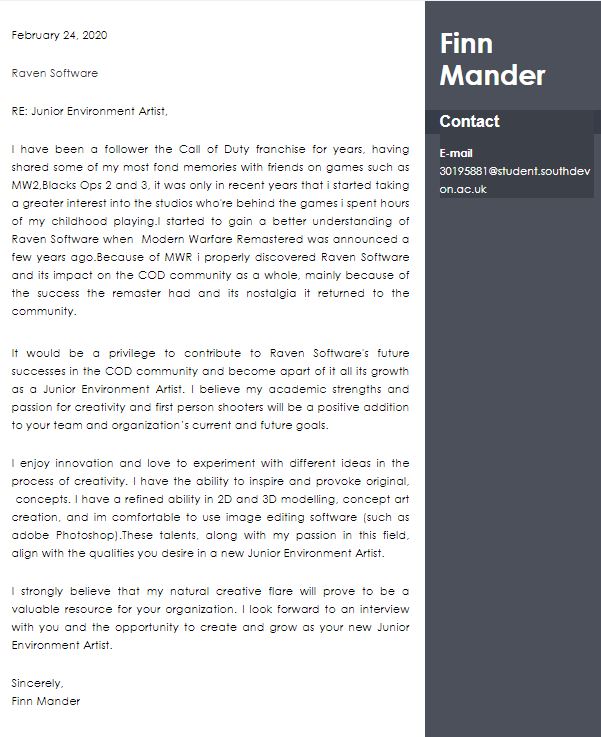
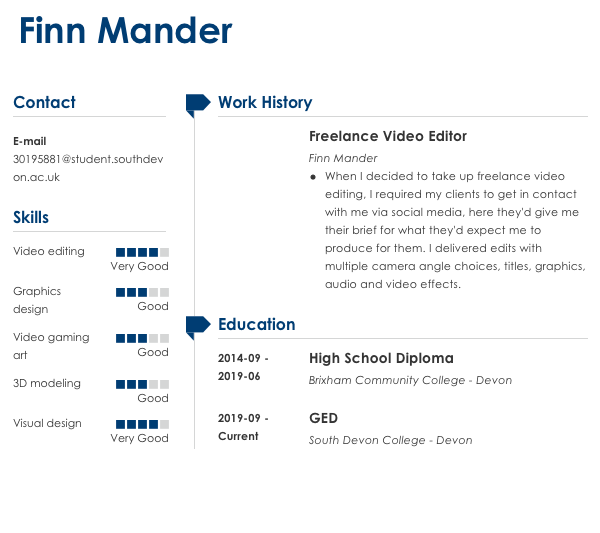
Task 4: Cover letter + CV,Job application. — 2020
Task 5 Working process —

Task 5 Working process

Skills, roles and responsibilities during my 3D environment creation (Task 6&7).

Because I planned to created a 3D environment my initial responsibility was to learn the necessary skills required so that I could begin the production process and achieve my end goal. Before I decided to create this 3D environment I had little past experience in creating 3D assets at all, nor any familiarity using software such as Cinema4D or Blender, so I took the responsibility upon myself to learn new skills via YouTube tutorials and general trial and error using Cinema4D on my computer at home during my spare time on the weekends or after college, these newly developed skills and techniques I was working on and picking up over the weeks would eventually be used once I began creating my 3D assets. During the time that I was focusing on learning how to improve my modelling skills I had to also manage my time during college hours, I found myself putting time into the research mainly, although when it came down to it creating the mood board it became very effective early on when I started to use it as a reference for me to build my virtual room off of, my environment was heavily influenced by the buildings left in ruin in games like Fallout 4 and The Last of Us, furthermore I also included real life examples such as the abandoned apartments of the Chernobyl, combining both virtual reality and real life I was able to build up a pretty realistic imagine of what I wanted my environment to look like before I had even finished my first real asset.

Skills, roles and responsibilities during the recording + editing of sounds (Task 5)

Similar to Tasks 6&7 i had no previous experience at all when it came to recording,editing and developing the sounds I needed for my game environment. When brainstorming for the sounds I mainly thought back to the games I had played before which had were of a similar genre to what I was planning to create. Using my what i remembered about these games such as I knew what types of sounds Id require to fully achieve my end goal. After I had planned out what I needed I then began to think of ways I could create sounds from scratch at home at home or sample 2 sounds together to create one, this was done with my the buzzing of the broken light sound effect for example.As stated earlier I lacked any prior experience with sound editing so I hadn’t used anything like Logic Pro X before, so once I had all the sounds prepared it was mainly down to messing around with all the different effects available until I was happy with the outcome. During the editing process I initially aimed to clean up the fuzzy background audio, I did this using the ‘Expander’ effect so that the main sound was made louder and the background audio was decreased in volume. – I used a YouTube tutorial for this tip.

Conclusion

In conclusion, i found the best way to overcome any challenge i faced was to either use tutorials available to me on YouTube or just spend an hour or so experimenting around on the programs.

Task 3 Skills/Progression Plan — 2020

Task 3 Skills/Progression Plan

Progression plan for going into the games industry

For the rest of this year and the next i will be continuing on with my current course at college, during the second year is when ill be heavily considering my future options, whether i enrol at a university, go straight into employment or find a higher apprenticeship position.

All these progression routes will eventually lead into the industry, however each of the three choices have their own advantages and disadvantages. For example if i were to secure a higher apprenticeship position after i finish my second year at South Devon, the higher apprenticeship has the possibility to last between two or three years. After i complete the higher apprenticeship, theres always the possibility that the studio which i enrolled as an apprentice for decides to offer me a position full-time. Although taking this route could get me into the industry quite easily.However i don’t think id take this pathway because of the “chance” that i might not be offered the position at company i was an apprentice for, resulting in me wasting a few years working as an apprentice for them. Id rather be able to give myself a better chance at getting into the industry by earning the further qualifications first needed to secure a job, instead of relying on the possibility that an employer decides to keep an apprentice on. To get the further qualifications needed id obviously need to enroll onto a university course. Using my research on relevant University courses available to me in task 1 i was able to see what courses would be available to me with the qualifications earned after i leave college a year an a half from now. For example if i decided to apply at Staffordshire University’s Computer games design and programming course .The course takes up to 3 years full-time or 4 years full-time taking me up to the 5th year mark. The course covers more than one skill in the design and programming industry, so in theory after graduation in theory id be a “jack of all trades”, having skills in both the programming and design/modelling sides needed in the industry, increasing my chances of employment. Being this “jack of all trades” will increase my chances of being hired by already established studios who are looking for multi skilled employees. One of the big disadvantages i see with this specific University course is the location. Id be required to move from Brixham to Staffordshire, which currently im unsure about doing so as its 200+ miles away from home. I aware that this industry doesn’t have a lot of opportunities available in my local area, with the ‘closest’ jobs (shown on ArtStation) being either in Brighton or Warwickshire and they’re still both around 200 miles away, so far this is the main disadvantage ive noticed when planning out my future after college, whether or not i want to move away this far away.

Task 2: Job research — 2020

Task 2: Job research

3D Modelling Artist:

What does a 3D modelling artist do?

A 3D Modelling artist creates the models for all 3D art assets found within a game, ranging from characters,vehicles,furniture,weapons,rocks,trees and so on. The process of creating a 3D model for a game will often start with a brief or a 2D drawing from a concept artist, which they will build their models based on. Depending on the individual game studio or game project requirements it isn’t uncommon for a 3D modelling artist to specialise in a given area. If this is the case a 3D modelling artist can become; environment artists, character artists or vehicle artists. However in other studios 3D modelling artists can be responsible for modelling several types of assets or an entire level.

The median annual salary for 3D artists is nearly £50,000. 3D artists earn around £30,000 annually, while the highest paid earn close to £85,000 a year.

What skills do 3D modelling artist possess?

  • Using 3D software: create artwork using a range of programmes, know the latest technologies and techniques
  • Using game engines: implement art into game engines, understand their technical constraints and possibilities
  • Art: have a strong artistic ability, good understanding of form,colour, texture and light, know how these elements work together
  • Knowledge of game play: imagine how a character or vehicle will be experienced when a game is being played
  • Collaboration: work well with other artists, designers and producers
  • Organisation: work within the production schedule, manage files and meet deadlines.

Tools used by 3D modelling artists today:

  • Image editing software (Adobe Photoshop)
  • 3D modelling, sculpting and painting software (blender,Cinema4D, 3D SMax,Maya, Mudbox, ZBrush, Substance Painter, Substance Designer, Quixel)

Working Patterns of a 3D modelling artist:

3D modelling artists commonly work normal office hours, (35 to 40 hours  weekly), if there are deadlines needing to met they may be required to work additional hours. Many artists work freelance,part-time and temporary contracts are also very common.

Concept Artist

What does a concept artist do?

Concept artists are largely responsible for the style and look of a game. They’re the first to draw the environments, enemies and player characters. Concept artists are given a brief from the game producer(s), which they will create sketches based on the briefs demands. These sketches are used to help 3D artists, producers, programmers and publishers understand how the game will look.

The drawings of the concept artist are a vital part of the game’s early development stages as they are the starting point for all the artwork and an important part for marketing plans.

Whats a concept artist good at?

  • Art: be very good at drawing by hand, understanding of composition, draw in a way that matches genre styles such as fantasy, sci-fi or cartoon.
  • Creativity: imagine how a character will look, starting from a written brief
  • Using art software: create 2D and 3D art using a range of programmes, know the latest technologies and techniques.
  • Communication: work with the other artists and in the team, share the vision with the designers and games developers
  • Knowledge of games: understand gameplay, have market awareness, appreciate how art will be experienced as a player

Who does a concept artist work with?

Concept artists work with all the other members of the art department. They report to the art director and often work closely with the creative director. The art department consists of; 3D modelling artists, Environment artists and Texturing artists.

The average salary for a Concept Artist is £24,000-£30,000 for an experienced concept artist, with starting salaries for entry level concept artists being between £17,000 and £20,000.

Working Patterns of a concept artist

The working hours of a concept artist varies a lot. Permanent office positions are quite different from freelance, it all falls down to what you’re working on at the time, whether its; mobile game, AAA game, movie. The size of the studio and teams also plays a role.

Marc Holmes, Senior Concept Artist and Illustrator- “It varies wildly. Mine is now sitting at home, working freelance. It used to be going into an office and managing a 40+ person art team in the morning and drawing all night. So it varies a lot. Depends on the project!”

From this answer on an AMA forum its clear that the hours are really quite versatile.

Professional behavior whilst working in the creative sector

  • Reliability
  • Time management, Attendance and punctuality
  • Commitment and Efficiency
  • Self-Presentation and Communication skills
  • Contribution to Team Projects
  • Personal Responsibility (more catered towards freelancers)

Pros and Cons

Pros:

Job security, growing industry and money

Cons:

Extra working hours to meet deadlines

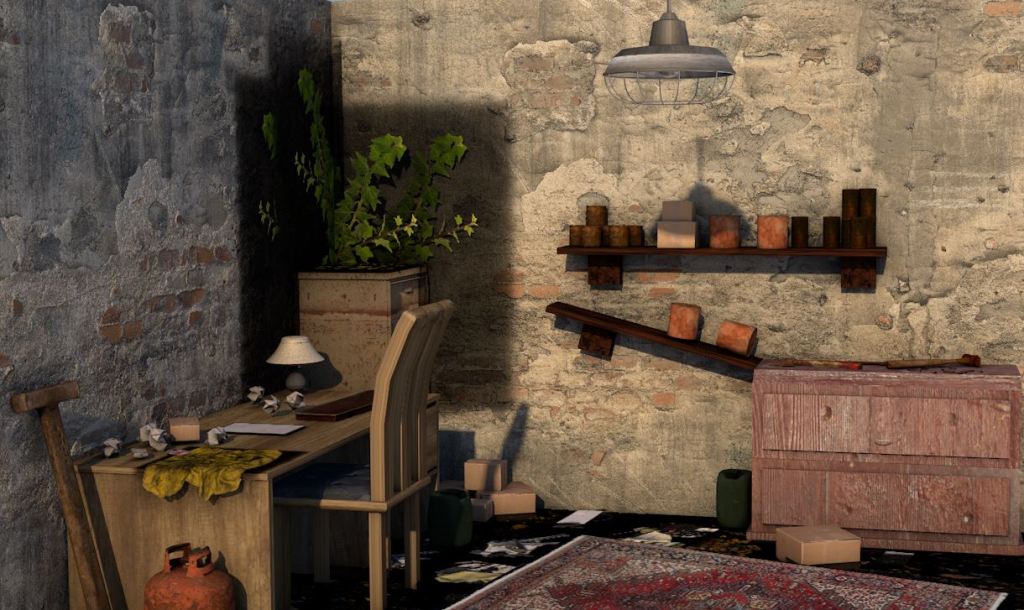
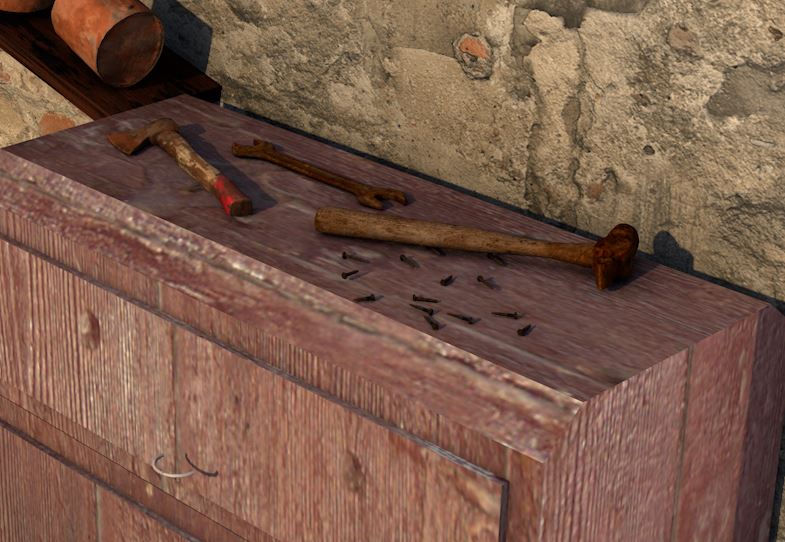
Final render of game environment — 2020
Design a site like this with WordPress.com
Get started