Candidate Authentication
I confirm that the attached assessment is all my own work and does not include any work completed by anyone other than myself and sources have been appropriately referenced.
Finlay Mander
1. Explore and evaluate methods for promoting yourself to employer and client.
Ways of Presenting yourself to an Employer.
Online Presence.
Having a strongly maintained online presence can be one of the best ways to stand out and make an impact in an interview. This online presence can be held on many different social media platforms, such as; Instagram or Pinterest. Building an online brand can provide better freelance work opportunities from private and industrial contractors. The ability to show that you can work efficiently whilst self employed, would come in very handy when applying to jobs that have competitive interview stages, proving to employers that you are responsible and self motivated.
Digital Portfolio.
Another way to promote yourself towards an employer requires a professional level digital portfolio. For instance, a candidate who has created a has created a digital portfolio demonstrating private freelance work done over the course of their career is doing so to display their relevant skills and abilities so that during the interview process they can put proof to their claims, its important to show, and tell. Creating a portfolio also avoids the chance of repeating yourself in an interview or missing out key information under pressure.
Why should you develop a digital portfolio? Having an impressive, unique portfolio behind you will make your pitch stay in the back of the minds of the employer(s) especially on days when they are interviewing large numbers of people, all of whom have the same academic achievements. A good portfolio can separate you from the rest.
A digital portfolio can present all forms of work and is used to show all the skills you currently possess. A digital portfolio can contain a website developed for a company, advertisement campaigns, private clientele work (freelance), TV and video production, games design, digital marketing. There aren’t any limits to what can be displayed on a portfolio in any industry. However its vital to keep your portfolio relevant to the who you’re being interviewed by. For instance, if you’re applying to create advertising campaigns for the NHS, a portfolio highlighting the work you did creating assets on a game last year wont be relevant. Making your pitch feel off, causing them to second guess their choices. Its expected by every industry that a digital portfolio will meet set standards. One of the key standards being visual. If the portfolio has high resolution images vs another which has low resolution small images its quite obvious which of the two would be more appealing to an employer.
CV.
A CV or curriculum vitae is a document created by a candidate that summaries their career history, this includes; academic qualifications, relevant skills, plans for the future and their potential at a company. A good CV should aim to impress potential employers, showing clearly your experiences and potential. It shall also include a personal summary, and an idea on what you expect/want to achieve from your career, goals and objectives. As mentioned previously – a career history and academic qualifications are important but its also important for a CV to highlight your areas of expertise, telling employers that you are above the rest.
What should a potential employer expect from your CV? A CV has to be of high quality, with relevant, useful information. Unlike a digital portfolio or a social media page, a CV is only going to be looked at by an employer. Therefore, its important to keep a CV up to date, similarly to how a portfolio or social media page is updated. Its important to modify it accordingly, adding new qualifications or skills achieved as you go through you career.
Progression Goals:
When I was deciding my progression goals I had to take into consideration the current circumstances going on at the moment with Covid and all the restrictions in place that come with the lock downs. Therefore my options limited, however I’ve been looking at progressing into higher education at South Devon University. It would make sense to go down this route anyway, since it will allow me to build on my skills and abilities.
Since I will most likely be going down this route, I need to research about writing a personal statement and then add it to my blog.
Personal statement research:
I used the information provided on the UCAS Personal Statement Tool to aid me when writing up the statement. It gave me information on, what a personal statement is, what to write about in one, how to write it and some dos and don’ts for when writing one up.
Key points:
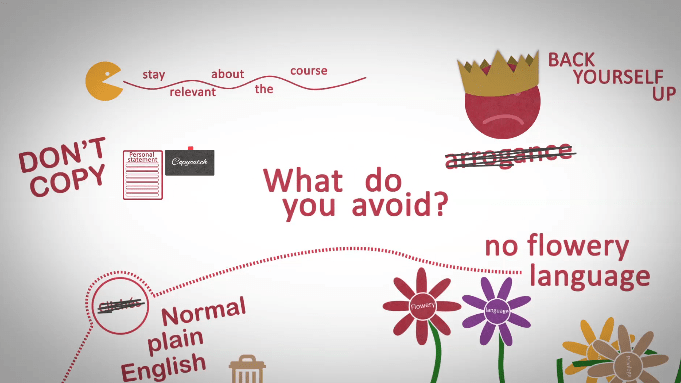
- Avoid showing off (arrogance).
- Don’t be negative (focus of the positives).
- Think about what makes you interesting, what makes you stand out.
- Avoid verbal diarrhea ( Be relevant about the course you’re applying for.
- To avoid showing off, when backing yourself up. Use relevant examples, like work experience, skills etc.
- Focus on plain English. Avoid flowery language// Avoid Clichés – Normal Plain English.
- Don’t copy (copy-catch software). Be authentic.
- Show that you know what you applied for.
Writing process:
- Start off with a punchy opening paragraph. Show an understanding on the course.
- Use middle paragraph to show evidence of interest in the course. Talk about your skills and good qualities.
- End paragraph (personal touch) talk about personal interests
Personal statement:
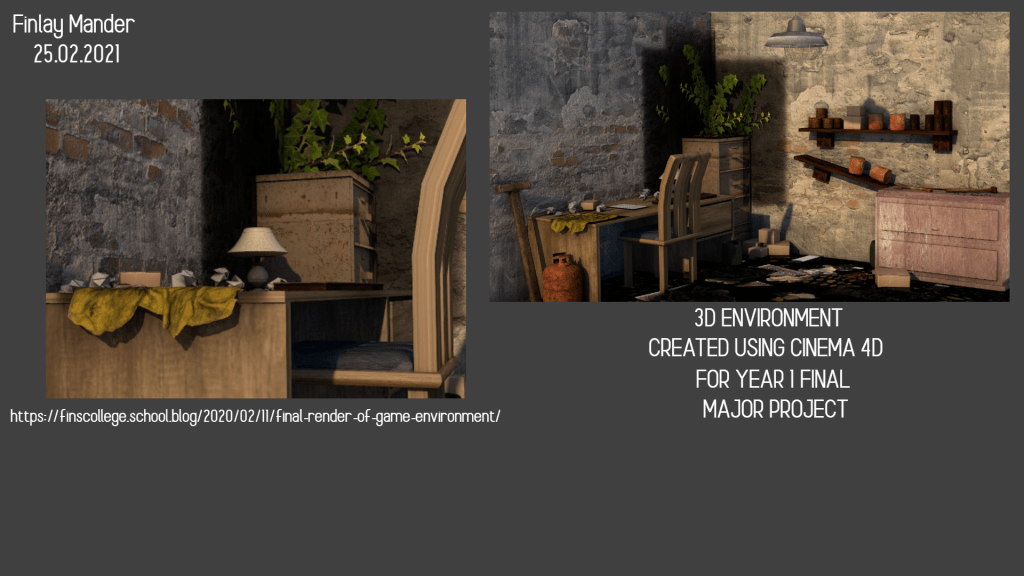
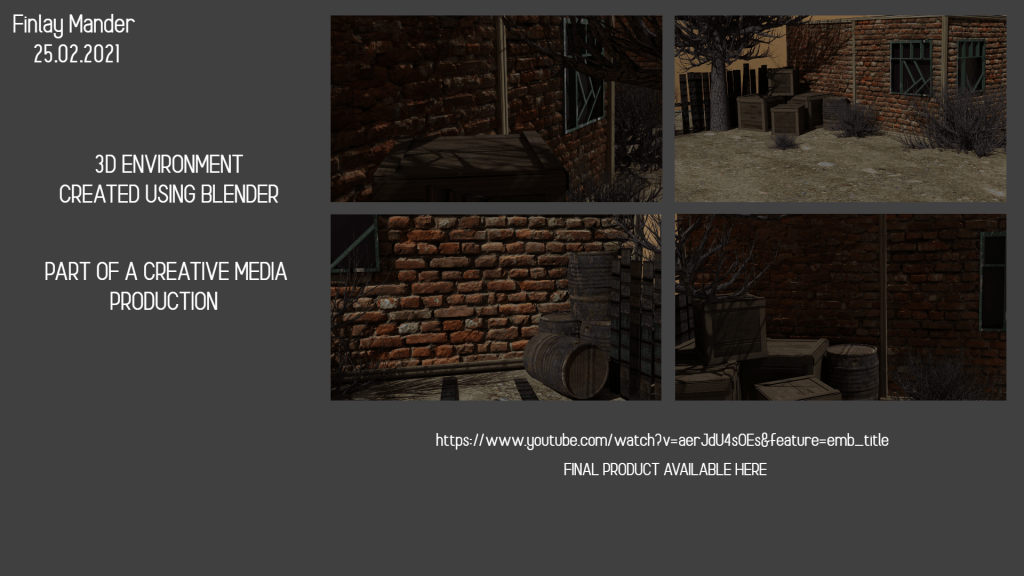
I would like to study Games and Interactive Design at university because I would like to peruse a career in the 3D industry. During my time at college I focused my 3D design work primarily on the creative side, having created 3D environments and assets for games. My program of choice currently is Blender, but I’m always able to experiment with alternative programs of choice, in my first year of the college course I used Cinema4D but by the end of the second I had transferred fully over to Blender.
However, the 3D industry isn’t just limited to games and over the past year I’ve started to notice this. Because 3D is becoming increasingly prevalent, more and more companies are starting to engage with it. Recently my Dad applied for planning permission and asked if I could create a 3D plan of part of our house,to help visualize what he wanted. So that it could be shown to the council. Although this was a relatively small task, the way I had to look at floor plans of our house to create accurate models was really interesting to me. Seeing how my house looked inside of the software and knowing I created it gave a sense of achievement. This task I was asked to do gave me a real world use for 3D outside the world of games and animation. This then got me interested in the other practical real world uses for 3D, for instance; 3D can also be used for the interior of buildings to be created before being filled with lighting, colour and furniture. This is used to give show how a finished room will look. A 3D model is used because it allows for things to be easily added and changed.
A strength of mine is being able to envision an idea and then see it through to the end of the final product. I think I earned this skill from when I was a massive Lego fan as a child, challenging myself to try and recreate sets I didn’t have from the boxes of random bricks I owned. Although I didn’t realize it then, the process I went through of looking at the adverts of the sets, videos or images has helped me when it comes to modelling assets in 3D now as I know what images are useful and how I can start from scratch and get to an end goal.
Digital Portfolio:
 Finn's Blog