RESEARCH
How 3D objects are created in games.
The vast majority of of 3D objects created for games are made up of polygons. A polygon is an area defined by lines, to have a polygon you must have at least three lines. These lines connect to a series of coordinates in the three dimensional “space” the computer creates the point where the lines connect is known as a vertex. Each vertex has X,Y and Z coordinates.
- X determines the position relative to right or left in the virtual space
- Y determines the position relative to top or bottom in the virtual space
- Z determines the position relative to front or back in the virtual space
Once each polygon has a set of vertices to define its shape, it needs information that tells it what to look like. There are four common ways to do this;
- Flat shading
- Gouraud shading
- Phong shading
- Texture mapping
Flat shading:
A single colour is assigned to a polygon. It is very simple and fast, but makes the object look artificial.
Gouraud shading:
Is more complex then flat shading because, colors are assigned to each vertex and then are blended across the face of the polygon. Since each vertex is typically associated with at least three distinct polygons, this makes the object look natural instead of looking artificial.
Phong shading
Improves upon Gouraud shading. Whereas Gouraud shading interprets colors by averaging between the vertices, Phong shading averages each pixel based on the colors of the pixels adjacent to it to create smooth surfaces.
Texture Mapping
Mapping requires the use of another image. Essentially, this other image is stretched over the object like a skin. This technique allows for games to have incredibly detailed 3-D environments that can be interacted with in real time.
Interview with lead designer of the Fallout New Vegas – Josh Sawyer.
https://www.theguardian.com/technology/gamesblog/2010/nov/10/fallout-new-vegas-interview
When asked “What do you think are the key elements of any post-apocalyptic story?“
Sawyer mentioned a few key points such as; the physical world in ruin is an “absolute must”. Even if there are piston pockets, the world we know has to be broken apart.” This can be reflected in nature: blasted trees, mutated plants, cracked earth, bizarre weather. It can be most strikingly shown through the destruction of everything humanity has created: Sawyer included that this with details of having critics in ruin, highways of empty cars, skyscrapers with every window blasted out.
According to Sawyer this ruin has to extend to human society, the world has to be socially and physically in shambles, with people living in small communities having very few organisations of any significant size in the wasteland.” Fallout: New Vegas shows post-2077 society at its most structured and ordered, but the Mojave Wasteland is still engulfed in chaos and warfare. Without order and under duress, human nature quickly turns very bleak.”
What do you think have been the key apocalyptic influences behind the Fallout series?
Sawyer mentioned there being a huge number of influences, but some of the more obvious were the Mad Max series, A Boy and His Dog, The Omega Man// I am Legend, and the documentary summaries of the Cold War era.
Art style of the Fallout series and the inspiration behind it
The series art style is heavily influenced by a unique brand of 1950s retro-futurism that was established in the original Fallout. “In Fallout: New Vegas, our lead artist, Joe Sanabria, pulled heavily from the Googie style which was very popular in the art and architecture of late 1950s Vegas.”
Googie style architecture
Ultramodern architectural style popular in post WWII American futurism. Its a style built on exaggeration; on dramatic angles; on plastic and steel and neon and wide eyed technological optimism.
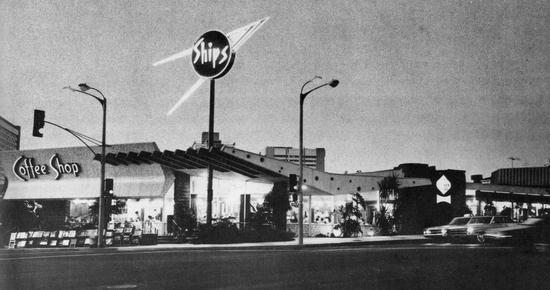
Googie style was a popular branch of 1950s Retro futurism
Retro futurism is evidence of what people of the past envisaged the future to look like. Made up of popping neon colors, svelte steel, curvy geometric shapes, and as much glass as possible, the designs are now laughable from the perspective of the present.
Fallout 4s art designs take on 1950s futurism seems to be that of an alternate history. The Art Deco stylings of interior decorating to the retro-futuristic technology of robot butlers is reminiscent of the ideas people had of the future.
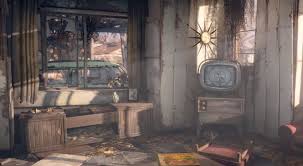
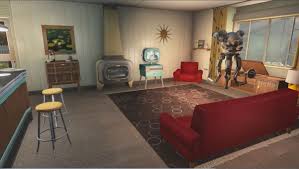
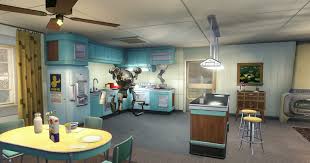
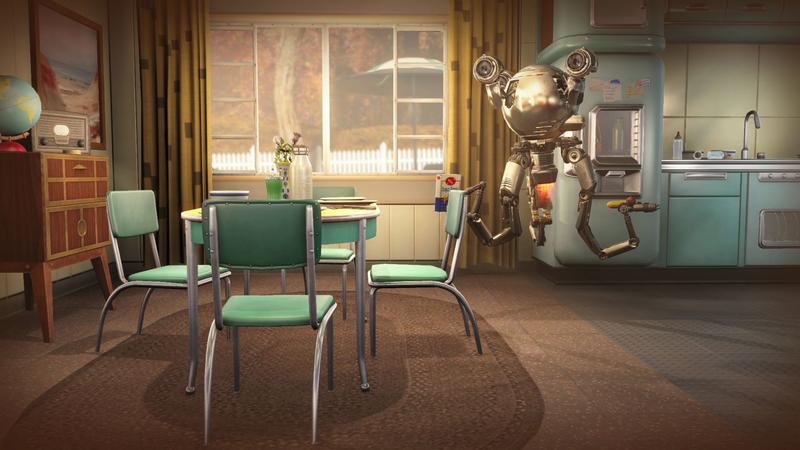
Lighting study
The lighting choices you make when developing your determine the mood for your game Lighting is one of the most influential roles in your game’s world and can make or break the visuals.
Interactive lighting
Almost every modern game is interactive, meaning that the lighting can often change based on the character’s actions. For instance, the player may have the ability to shoot out a light and completely alter the game world instantaneously. The lighting in a scene can also change simply based on the player’s current position and perspective in the game. If the player moved to a different spot, they’d see reflections and light rays very differently.

Lights in games are typically created by the many different built-in light tools found in the game engine. One of those tools is the ability to bake lights on to the materials in order to save render time.
Light has a drastic effect on the feel of a game; it determines how a player interacts with and views the world they’re playing in. For instance, look at a horror game. There’s always a specific lighting technique used throughout the game to help achieve a sinister and ominous feel to keep the player on edge. The lighting is much darker with deep shadows for creatures to hide in. Sometimes the light may only be coming from the flash light the player is holding, giving the player complete control of the lighting.
Establish a Light Source
Establishing light for your game is determining the light source. These sources can vary whether it’s the sun, moon, a street lamp or a light on the ceiling etc.
 Finn's Blog